Module 5 Learning Activity: Exploring speculative approaches to digital education futures

Summay:

  • The speaker discusses the significance of speculative methods and pedagogies in shaping education futures. They share examples of speculative work, including the “Teacher Bot” project, which challenged assumptions about automation and teacher-student relationships in a MOOC. The presentation emphasizes how speculative approaches create alternative educational futures, challenging established narratives and fostering new possibilities. The speaker also addresses challenges and considerations in conducting speculative work and invites further discussion on the topic’s implications for digital education research and practice.


Digital technologies, including digital education, have a complex relationship with climate change. On one hand, they offer opportunities to reduce environmental impacts by enabling remote work and online learning, which can decrease the need for physical travel and infrastructure. However, these technologies also come with their own environmental costs, primarily related to energy consumption and electronic waste. It require vast amounts of energy to power data centers, servers, and devices. The energy sources used to support these technologies can have significant carbon emissions, contributing to climate change. Additionally, the manufacturing and disposal of electronic devices contribute to electronic waste and the depletion of natural resources.

Educational institutions do have a responsibility to assess their environmental footprint, including the impact of their digital initiatives. Here’s why:

  • Ethical Responsibility: Educational institutions are responsible for preparing students to be informed and responsible citizens. Part of this responsibility includes modeling sustainable practices, which includes assessing and mitigating their environmental impact, including digital technologies.
  • Role Modeling: Institutions play a role in setting norms and behaviors for their students and communities. By prioritizing sustainable digital practices, they can influence broader societal attitudes towards technology and climate change.
  • Learning Opportunity: Incorporating discussions about the environmental impact of digital technologies into educational programs provides students with a deeper understanding of the complexities of sustainability and the trade-offs associated with technology use.
  • Resource Efficiency: Assessing and optimizing digital infrastructure can lead to more efficient use of resources, reducing energy consumption and waste.
  • Long-Term Savings: Implementing sustainable digital practices can lead to cost savings in terms of energy consumption and equipment lifecycle.
  • Innovation: Encouraging discussions and research on sustainable technology can drive innovation in developing more energy-efficient digital solutions.

To assess their environmental footprint, educational institutions can take various steps:

  1. Energy Consumption Analysis: Determine the energy sources powering digital infrastructure and evaluate energy consumption patterns.
  2. Carbon Footprint Assessment: Evaluate the carbon emissions associated with digital technologies and identify ways to reduce them.
  3. Resource Management: Implement strategies to extend the lifecycle of devices, reduce electronic waste, and promote recycling.
  4. Renewable Energy Adoption: Transition to renewable energy sources to power digital infrastructure whenever feasible.
  5. Awareness and Education: Raise awareness among staff, students, and stakeholders about the environmental impact of digital technologies and promote responsible usage.
  6. Policy Development: Develop and enforce policies that encourage sustainable digital practices and promote energy efficiency.

In conclusion, digital technologies can both contribute to and mitigate climate change. Educational institutions have a responsibility to assess and manage their environmental footprint, considering the implications of their digital initiatives on sustainability and incorporating these considerations into their educational programs.

Module 4 Learning Activity: What is happening with open learning?

This session has given us information about open education, with a special attention to Lumen Learning and its founder, David Wiley, who is considered a visionary. As we have followed the development of open education, we can see that the use of open resources, innovative teaching methods, and the quest for fairness in education have advanced.

David Wiley’s work is influential in the open education movement. His groundbreaking work at Lumen Learning is an example of how open educational resources (OER) can transform education. Wiley has had a crucial role in shaping discussions about openness in education, particularly when it comes to bridging the digital gap and rethinking course design.

Educators and institutions are facing new challenges, which involve integrating open approaches into teaching practices more smoothly. The goal is to offer high-quality, flexible resources while still offering the convenience that traditional publishers provide. Maintaining this delicate balance highlights the need for continuous support and collaboration to ensure the full realization of the benefits of OER.

As we look to the future, open education’s path remains positive, driven by committed individuals such as David Wiley and organizations like Lumen Learning. The pursuit of educational equity and accessibility persists; collaborative efforts, innovative solutions, and a shared commitment to shaping a more inclusive and transformative learning environment for all drive it.

Open Educational Resources (OER) are freely accessible and openly licensed learning materials that can be used, shared, and modified by educators and learners. OER-enabled education focuses on using these resources to improve teaching and learning. This approach involves integrating OER into curriculum design, allowing educators to access, adapt, and customize educational content according to their instructional goals and the needs of their students. OER-enabled education promotes affordability, access, and flexibility in education by reducing reliance on traditional, expensive textbooks and proprietary resources.Open pedagogy is an approach to teaching that goes beyond the use of open resources. It promotes collaborative and participatory learning experiences in which students actively engage in the co-creation of knowledge and educational materials. Open pedagogy emphasizes student agency, creativity, and critical thinking. Educators design assignments and projects that encourage students to contribute to the production of openly accessible content, fostering a sense of ownership and deeper understanding of the subject matter. Open pedagogy may involve the creation of wikis, blogs, digital portfolios, or even open licensing of student work, allowing for a more interactive and learner-centered educational experience.

To sum up, OER-based teaching highlights the use of open resources to enhance usual teaching methods. Open Pedagogy, on the other hand, urges a more collaborative, student-centered approach that fosters co-creation of academic content by students.
The interesting points from the discussion, I think is digital divide .The meeting didn’t talk too much on it, nut I want to expand on that.The digital divide does indeed add another layer to reinforce socioeconomic barriers for students. The digital divide refers to the disparity in access to technology and the Internet based on factors such as socioeconomic status, geographic location, and demographic characteristics. This divide can exacerbate existing inequalities in education and prevent students from marginalized backgrounds from fully participating in online learning and accessing digital resources.

When students lack reliable Internet access, appropriate devices, or the digital skills necessary for online learning, they face challenges in keeping up with their studies. This can lead to incomplete assignments, missed lectures, and reduced engagement, ultimately affecting their academic performance. As education increasingly relies on digital platforms and online resources, students without access to these tools are at a significant disadvantage.

In addition, the digital divide affects not only students’ academic progress, but also their ability to develop critical digital literacy skills that are becoming essential for success in the modern world. As more job opportunities and essential services move online, individuals without digital skills may find it difficult to access employment opportunities and participate fully in society.

We need to effort to bridge the digital divide are critical to addressing these inequalities. Initiatives that provide affordable or free Internet access, distribute devices to underserved communities, and offer digital literacy training can help mitigate the impact of the digital divide on socioeconomic barriers. By ensuring equitable access to technology and digital resources, society can work to create a more inclusive educational environment and reduce the widening of socioeconomic disparities.

I chose this activity because it articulated the realities that open pedagogy encounters and made me reflect on the fact that only with technological advances can we try to bridge the digital divide. Several points were discussed at this activity, including  Large Language Modeling, Generative AI. In open pedagogy  these tools helps you get faster, further, less expensively. This aligns with my learning goal of working to explore the connections between cutting-edge technology and open pedagogy.

Module 3 Learning Activity: Harnessing the Power of AI in Education


I chose to participate in this activity because, as a Computer Science major, researching how to develop AI and using AI tools are essential skills. This activity is in line with the goals of my studies, as I am interested in the impact of cutting-edge technology fields on open education. Through a critical review of this experience, I have learned that the application of AI to education has a lot of potential and comes with a lot of problems. I am currently concerned about unemployment and dependency.

Module 2 Learning Activity: Connectivism in your Discipline

A brief summary of the article, central to connectivism was the concept that knowledge is distributed across networks, and learning occurs through engagement with this decentralized information. Instead of a linear transfer of knowledge from educators to learners, learning involves dynamic interaction with information and peers. This approach resonated with the inherent nature of the internet, characterized by decentralization, interconnectivity, and fluidity.

However, connectivism faced challenges for learners in such networked courses, including the requirement for self-directed learning, maintaining a high online presence, and developing critical digital literacies. Students’ reactions varied, with some finding the approach liberating and others feeling uncertain or isolated.

Considering the common teaching practices of my major computer, I think connectivism has been applied here. Talking from my experience this semester, software engineering courses asking students to complete assignments that require to using  many unfamiliar skills and are not taught by the professor too much in the course. We need to start with the subjects, search the vast amount of contents on internet, and filter out useful ones. Often I didn’t know if the code worked, or why it worked, I relied more on the Internet rather than course materials. I think the advantage of this mode of teaching is that it cultivates your independent learning ability. After you understand and master Connectivism, it will help you in your future work and life.

Aggregation: Professor encourages students to use AI tools, such as ChatGPT to curate vast amounts of information from diverse sources. Instructors play a role in guiding learners on effective aggregation practices, teaching them how to fine-tune algorithms and critically assessing the quality of sources.

Relation: We use Stack Overflow is a online communities for programmer where we can engage in rich discussions and debates.

Sharing: In the reimagined Connectivism, sharing transforms into purposeful dissemination. GitHub is a platform and cloud-based service for software development, allowing developers to store and share their works.

Creation: Creation has not yet been realized. I think that in the future, it may not be possible to limit the code language used by students. It is result-oriented. It is estimated that everyone will use various possible attacks

I chose this activity because it relates to my learning career and aligns with my goals of exploring the impact of technology on open learning. I believe that in the future, we will need to acquire and learn a lot of information online. Knowing how to effectively sort information using the right tools will be crucial then. This activity has made me reconsider artificial intelligence and how intelligent algorithms are applied.


EDCI 339 Module 1 Learning Activity: 25 Years of Ed Tech

After reading the Weller’s 25 Years of Ed Tech, I’m interested in chapter 24: Blockchain. Blockchain being a concept that has been hyped up in recent years, I was curious and eager to see how it related to education.

In conclusion of this chapter, the integration of blockchain technology in the realm of education remains a perplexing endeavor, both in terms of its mechanics and its purpose. This inclusion is not only due to its widespread attention but also serves as an illustration of the type of hype that surrounds nascent technologies that struggle to address a distinct need. Technically speaking, blockchain operates as an incorruptible digital ledger of economic transactions that holds the potential to record an array of valuable data beyond just financial dealings. Its decentralization prevents hacking and offers a means to bypass intricate networks of intermediaries required for transaction validation.

Blockchain, however, seems to be a technology searching for an appropriate application in the educational context. The question of how it relates to education, students, and learning often arises, leaving many to ponder the true value it brings. The proposal of blockchain’s application in education frequently stems from its intriguing nature rather than from a clearly identified educational necessity. While some scholars suggest potential impacts, such as secure certification systems, verification of validity, data ownership, and cryptocurrency payments, these applications could often be achieved using existing technologies. The adoption of blockchain technology for educational purposes could also lead to unforeseen environmental consequences, given its substantial energy consumption.

Historically, similar technology-driven initiatives within the educational technology field have experienced slow adoption and limited success. The eagerness to brand existing solutions with the allure of blockchain innovation is prevalent, leading to rebranded offerings and media coverage. Despite claims of transparency, blockchain often lacks documented results and data to support its touted impacts. This aura of magic can hinder true understanding and thoughtful evaluation of the technology’s relevance.

Furthermore, the parallel between blockchain’s promotion and the historical alchemical mindset is evident. Both exhibit traits such as greed, obfuscation, a magical lexicon, vagueness, occasional side benefits, and persistence. A critical perspective is required to distinguish between valid implementations and technological overreach. Openness, specific problem-solving, and a discerning approach to technological solutions are essential to avoid falling into the trap of pursuing illusory solutions, just as the pursuit of alchemy detracted from actual scientific progress.

As a computer science student, I chose this topic because it aligns with my learning goals, as I am committed to exploring the impact of cutting-edge fields on open education. I think the application of blockchain technology in education is a bold and innovative attempt, and although we haven’t achieved any significant results yet, I believe that one day it will be deeply bound to education. For example, from what I know I think making the degree certificates in the form of NFT is a good idea. A non-fungible token (NFT) is a unique digital identifier that is recorded on a blockchain, and is used to certify ownership and authenticity. It cannot be copied, substituted, or subdivided. So the risk of falsification of qualifications is avoided, and they are transparent and traceable, and everyone can verify their authenticity.


Welcome and Introduction

Welcome to your WordPress website for EDCI339. Here are some first tasks to explore with your new site:

  • Go into its admin panel by adding /wp-admin at the end of your blog’s URL.
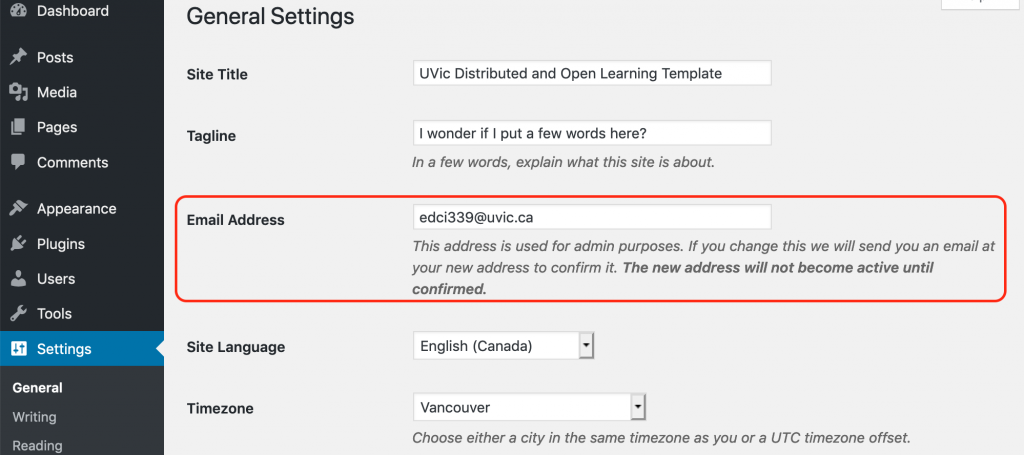
  • Tap “Settings” and change the email address to your email address, then make sure you check your email and confirm the change.

change email address

  • Change the title and tagline for your site under Settings -> General
  • Add new categories or tags to organize your blog posts – found under “Posts” (but do not remove the pre-existing “Distributed & Open” category)
  • Edit the “About Me” or create a new page welcoming visitors to your site.
  • Embed images or set featured images and embed video in blog posts and pages (can be your own media or that found on the internet, but consider free or creative commons licensed works, like found at unsplash.com or pexels.com)
  • Under Appearance:
    • Select your preferred website theme and customize to your preferences (New title, etc.)
    • Customize menus & navigation
    • Use widgets to customize blog content and features

© 2025 EDCI-339

Theme by Anders NorenUp ↑